Scaling a high-growth brand creates an opportunity—and an operational challenge. As order volume increases and new sales channels emerge, fulfillment becomes more complicated. Direct-to-consumer (DTC) orders, influencer campaigns, wholesale distribution, retail compliance, and event logistics can quickly overwhelm systems designed for simpler operations.
Timeline, a health and longevity brand offering products backed by clinical research, encountered this challenge as it expanded. The company needed more than additional warehouse capacity. It needed a multi-channel fulfillment system capable of supporting increasingly complex logistics without sacrificing visibility or control.
TCB Global helped build that operational structure.
The Challenge: Multi-Channel Fulfillment at Scale
Timeline had built credibility in the health and longevity market through scientific research, premium product development, and a strong brand presence. Growing demand brought tens of thousands of DTC orders alongside influencer campaigns, trade shows, product launches, and expansion into wholesale and retail.
Each channel introduced different fulfillment requirements.
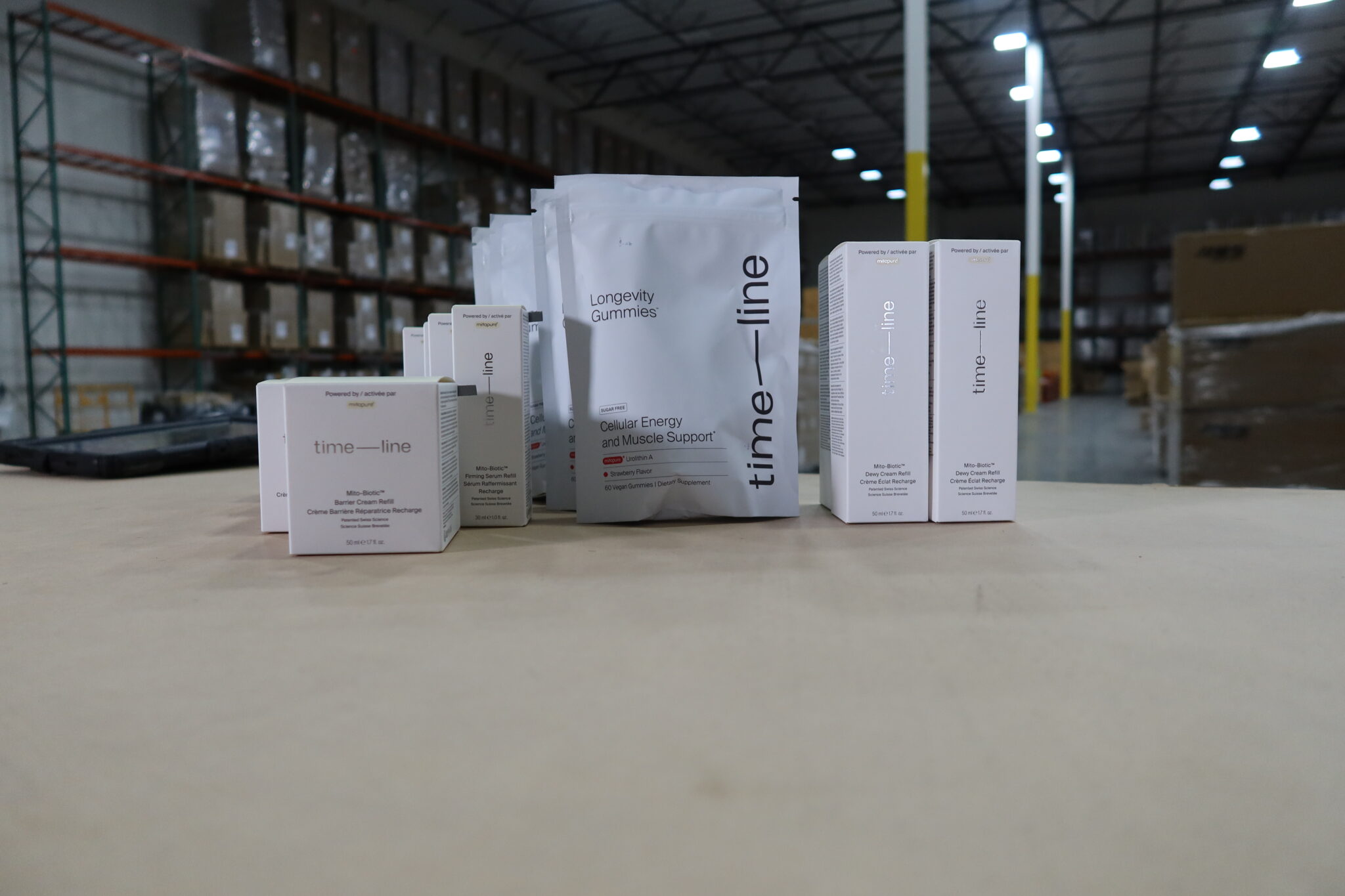
Influencer kits required custom packaging, multiple SKUs, specialized components, and consistent presentation. Some components were connected to clinical trials and required precise tracking.
Trade shows introduced another layer of coordination. Inventory had to be staged, tracked, and delivered according to event schedules.
Meanwhile, wholesale expansion required Timeline to navigate electronic data interchange (EDI), retailer-specific labeling and packaging requirements, and strict delivery guidelines—all while maintaining its DTC operation.
The challenge wasn’t one fulfillment channel. It was managing all of them simultaneously.
Why Fragmented Fulfillment Was Becoming a Problem
As Timeline evolved from a high-growth DTC company into a multi-channel brand, fragmented processes created additional operational pressure.
Influencer and marketing kits were labor-intensive and difficult to scale without standardized assembly workflows. Event logistics required coordination across destinations and deadlines. Wholesale fulfillment added compliance requirements that differed significantly from individual ecommerce orders.
Inventory positioning also became increasingly important. Relying on a single fulfillment point can increase shipping distances and transit times as a customer base expands geographically.
Finally, Shopify, ERP, EDI, and warehouse operations needed to exchange information effectively. Without alignment between these systems, teams can face additional manual work and reduced inventory and order visibility.
Timeline needed a structure that connected these requirements rather than treating each as an isolated operation.
The Turning Point: Building a Unified Fulfillment System
Timeline didn’t need to eliminate operational complexity. It needed infrastructure capable of managing it.
TCB Global approached the relationship by developing a unified operational structure across fulfillment channels. The goal was to create repeatable workflows while supporting Timeline’s changing requirements.
The relationship centered on TCB Global’s ability to support multiple fulfillment models, complex kitting, wholesale and EDI requirements, event logistics, and scalable distribution.
Instead of functioning solely as a warehouse shipping individual orders, TCB Global became part of the operational infrastructure supporting Timeline’s growth.
How TCB Global Built a Multi-Channel Fulfillment Solution
The first priority was centralizing fulfillment processes to improve visibility and control across channels.
TCB Global established structured workflows for Timeline’s influencer and marketing kits. These processes supported accurate kit assembly, appropriate handling of specialized components, and consistent presentation. Turning custom kitting into a repeatable workflow made it easier to support marketing initiatives as campaign requirements changed.
Trade show logistics were also organized around event timelines. Inventory could be tracked, staged, and distributed according to individual event requirements rather than handled as an ad hoc shipping project.
Wholesale fulfillment required deeper integration. TCB Global worked with Timeline’s ERP and EDI providers to support the flow of wholesale orders and meet applicable retailer fulfillment requirements.
This allowed wholesale distribution to operate within the broader fulfillment structure instead of becoming a separate logistics process.
Improving Distribution With Multi-Node Fulfillment
As Timeline’s reach expanded, inventory positioning became another component of its multi-channel fulfillment strategy.
TCB Global operates locations in Orlando and Las Vegas, providing strategic distribution points for brands serving customers across the United States. For Timeline, multi-node distribution created an opportunity to position inventory closer to customers rather than relying exclusively on one shipping origin.
Strategic inventory positioning can reduce shipping zones and transit distances while supporting faster delivery.
System alignment was equally important. Connecting Shopify, ERP, and fulfillment workflows helped support real-time order flow, accurate inventory tracking, and less manual intervention.
The objective was straightforward: make multiple channels operate as parts of one logistics system.
The Results: Scaling Without Adding Fulfillment Friction
Timeline moved from increasingly fragmented logistics toward a unified fulfillment structure capable of supporting multiple channels.
Influencer and marketing kits could be assembled through standardized processes. Trade show inventory could be coordinated around event requirements. Wholesale orders could be processed according to retailer requirements, while DTC fulfillment continued at scale.
Multi-node distribution improved the brand’s ability to position inventory strategically, and connected systems increased operational visibility.
Most importantly, Timeline could continue growing without requiring its logistics model to remain static.
Instead of reducing the complexity created by new channels, the fulfillment system was designed to accommodate it.
Multi-Channel Fulfillment FAQs for Growing Brands
How do brands scale fulfillment across multiple channels?
Brands can scale fulfillment by integrating DTC, wholesale, retail, kitting, and event logistics into a unified operational structure. Centralized inventory visibility, standardized workflows, system integrations, and appropriate distribution locations help prevent channels from becoming disconnected operational silos.
What is EDI in retail fulfillment?
Electronic data interchange, or EDI, enables retailers and suppliers to exchange standardized business documents electronically. For growing brands, EDI can be essential for processing retailer orders and meeting trading-partner requirements.
How can brands manage influencer kits at scale?
Scalable influencer fulfillment requires standardized processes for component tracking, assembly, quality control, packaging, and distribution. Repeatable workflows help maintain consistency as campaign volumes increase.
When should a brand consider multi-node fulfillment?
Multi-node fulfillment becomes valuable when geographic order distribution makes a single fulfillment location inefficient. Strategically positioning inventory can reduce shipping distances, improve delivery times, and create a more scalable national distribution model.
Why Growing Brands Choose TCB Global
TCB Global supports brands navigating the intersection of growth and operational complexity. Its capabilities include multi-channel fulfillment, complex kitting, wholesale and EDI integration, trade show logistics, inventory optimization, and multi-node distribution.
For growing brands, the goal isn’t simply to ship more orders. It’s to build logistics infrastructure capable of supporting the next stage of the business.
Timeline’s experience demonstrates the difference.
Growth increased operational complexity. Instead of allowing that complexity to become a constraint, Timeline and TCB Global built a fulfillment structure designed to support it.
If your brand is expanding across DTC, retail, wholesale, events, or other channels, your logistics infrastructure needs to support where the business is going—not where it has been.
TCB Global builds multi-channel fulfillment systems designed to scale with growing brands.